

What if the biggest risk to your smartphone isn’t the shattered screen, but the person you pay to fix it? In 2026, handing over an unlocked device to a stranger feels less like a professional service and more like a voluntary security breach. You shouldn’t have to choose between a functional device and your digital privacy. Finding a reliable data safe phone repair London specialist is no longer just a convenience; it’s a necessity for anyone with banking apps, private photos, or sensitive corporate data on their device.
We understand the genuine anxiety of leaving your iPhone or Samsung in a high-street shop, wondering if your private folders are being browsed whilst you wait. You likely feel that a factory reset is the only way to stay safe, even though it’s a massive logistical hassle. This guide will show you how to protect your information whilst getting your device professionally repaired. We explore the 2026 UK Right to Repair standards, the transparency of on-site repairs you can witness personally, and how our specialised B2B HUB maintains absolute security for London professionals.
Key Takeaways
- Define the “Data-First” standard where hardware repairs are performed without compromising software or requiring personal passcodes.
- Learn how to utilise 2026 privacy modes and encrypted backups to shield your banking, health, and biometric data before any technician interaction.
- Evaluate why on-site service represents the only truly data safe phone repair London model by keeping your device in sight at all times.
- Implement a non-negotiable five-step security checklist to maintain a secure chain of custody for your iPhone, iPad, or Samsung device.
- Discover how professional on-site transparency eliminates the need for factory resets whilst ensuring zero unauthorised access to your private folders.
What is Data Safe Phone Repair and Why Does it Matter in London?
A data-safe repair isn’t simply about restoring a cracked iPhone screen or replacing a Samsung battery. It’s a specialised protocol that ensures zero unauthorised access to your device’s software whilst the hardware is being serviced. In a city like London, where your smartphone acts as your primary digital identity, the stakes are incredibly high. Your device holds banking apps, health records, and biometric data that, if compromised, could lead to identity theft or financial loss. The stakes are high. It’s no longer just about a broken glass panel; it’s about who can see your life.
The landscape changed with the UK Data (Use and Access) Act 2025. This legislation forced a shift in professional standards, making it clear that repair shops have a legal duty to protect the information they handle. It isn’t just a best practice anymore; it’s a compliance requirement for any legitimate business operating in the capital. As part of the broader Right to Repair movement, consumers now have more power to demand transparency. For the modern London professional, this means moving away from “black box” repairs and towards models where privacy is the priority. Choosing a data safe phone repair London specialist is the only way to ensure your digital life remains private whilst your physical hardware is restored.
The Risks of Traditional High-Street Repair Shops
When you hand your phone over a counter and watch it disappear behind a curtain, you lose control. Traditional shops often require you to leave your device for hours or even days. This creates several critical vulnerabilities that many users overlook until it’s too late. You shouldn’t have to trust a stranger with your entire digital history.
- Unauthorised Browsing: Without strict oversight, technicians can browse private photo galleries or message logs under the guise of “testing.”
- Data Cloning: Sophisticated software can clone a device’s entire contents in minutes, which often occurs during overnight “storage” in unsecured workshops.
- Password Demands: Many shops insist on your passcode for hardware fixes where it isn’t actually required, giving them unfettered access to every app you own.
Corporate Liability: B2B Device Security in 2026
For businesses, the risk is exponential. A single compromised employee phone can trigger a catastrophic corporate GDPR breach. If an iPhone or iPad containing sensitive client emails or legal documents is accessed by an unvetted third party, the firm faces massive fines and reputational ruin. This is why many organisations now insist on a dedicated corporate phone repair London service. These hubs utilise vetted technicians and strict security protocols designed specifically for the finance and legal sectors, ensuring that hardware fixes never compromise corporate secrets or client confidentiality. Privacy is a professional obligation.
Technical Safeguards: Preparing Your Device for a Secure Fix
Securing your data begins long before you meet a technician. Before any interaction, performing an encrypted local or cloud backup is non-negotiable. This ensures that even in the unlikely event of a hardware failure during the fix, your digital life remains intact. It’s also vital to follow official NCSC device security guidance regarding data encryption and remote wiping capabilities. For most hardware-only issues, such as a shattered iPhone screen or a failing Samsung battery, a factory reset is often unnecessary. These are physical component swaps that don’t require software interaction. To further prevent physical data theft, always remove your SIM card and any microSD cards. These small chips are easily pocketed and contain vast amounts of personal contact and location history.
Utilising “Repair Mode” on iOS and Android
Modern operating systems have introduced specific features to facilitate a data safe phone repair London. Apple’s Repair State allows technicians to run essential diagnostics whilst keeping your personal data fully encrypted and inaccessible. Similarly, Android users can activate Maintenance Mode before handing over their device. Maintenance Mode is a secure sandboxed environment that allows repair personnel to test the phone’s functions without seeing your photos, messages, or apps. Utilising these built-in tools provides a layer of digital armour that traditional shops often fail to mention.
Managing Activation Locks and Passcodes
One of the most common points of confusion is whether to share your passcode. For a professional screen replacement, a technician should not require your code. Providing it grants unfettered access to your entire digital identity. Whilst some manufacturers insist on disabling Find My iPhone to verify part authenticity, this should be done in your presence to maintain security. Reliable services like iRepairMan London prioritise your privacy by repairing devices whilst they remain locked. This locked-fix protocol ensures that no one can browse your private folders during the hardware replacement. If a technician insists on your passcode for a simple screen repair without a valid technical reason, it’s a significant red flag. Choosing a professional on-site repair allows you to manage these settings in real-time, ensuring your device is never left in an vulnerable, unlocked state.
Comparing Repair Models: Which is Truly Data Safe?
Not all repair paths are created equal. When your device breaks, you usually face three choices: a high-street shop, a mail-in service, or an on-site technician. Each model carries a distinct security profile. High-street shops often require you to leave your phone overnight, creating a “black box” where you’ve no idea who is accessing your files. Mail-in services introduce the “Chain of Custody” problem. Between your front door and the repair bench, your device passes through couriers, sorting hubs, and multiple staff members. Every hand that touches your package is a potential security vulnerability. For a truly data safe phone repair London experience, the on-site model remains the superior choice for those prioritising privacy over mere convenience.
The primary difference lies in the nature of the risk. While data loss can happen anywhere, data theft is much harder to execute when you’re in the room. Professional on-site repairs in Central London offices or homes provide the highest privacy assurance because the device never leaves your physical environment. You aren’t just trusting a brand; you’re witnessing the process. This eliminates the risk of “cloning” or unauthorised backups that can occur in off-site workshops. Experts suggest that securing your personal data involves more than just passwords; it requires controlling the physical location of the hardware at all times.
The On-Site Advantage: Visual Transparency
Transparency is the ultimate security feature. Watching a technician work prevents any unauthorised software interaction. There’s an immense psychological peace of mind that comes with a 30-minute iPhone screen repair London performed right at your desk. You see the screen coming off. You see the new one going on. No cables are plugged into the data port for “diagnostics” that you didn’t authorise. These “while you wait” services are the gold standard for data safety because they remove the opportunity for foul play. It’s fast. It’s secure. It’s professional.
Mail-In and Pick-and-Return Security Protocols
For those outside the capital, on-site isn’t always an option. In these cases, you must vet your phone repair pick and return UK provider with extreme care. Look for services that utilise tamper-evident packaging. This ensures that if a courier or third party attempts to open the box, it’s immediately obvious upon arrival at the lab. Modern repair logistics for sensitive clients, such as schools and nurseries, now include tracked, insured transit and vetted technicians who adhere to strict data integrity standards. Whilst mail-in carries more logistical steps, a provider with a “Data-First” philosophy can still offer a secure alternative to risky high-street shops.
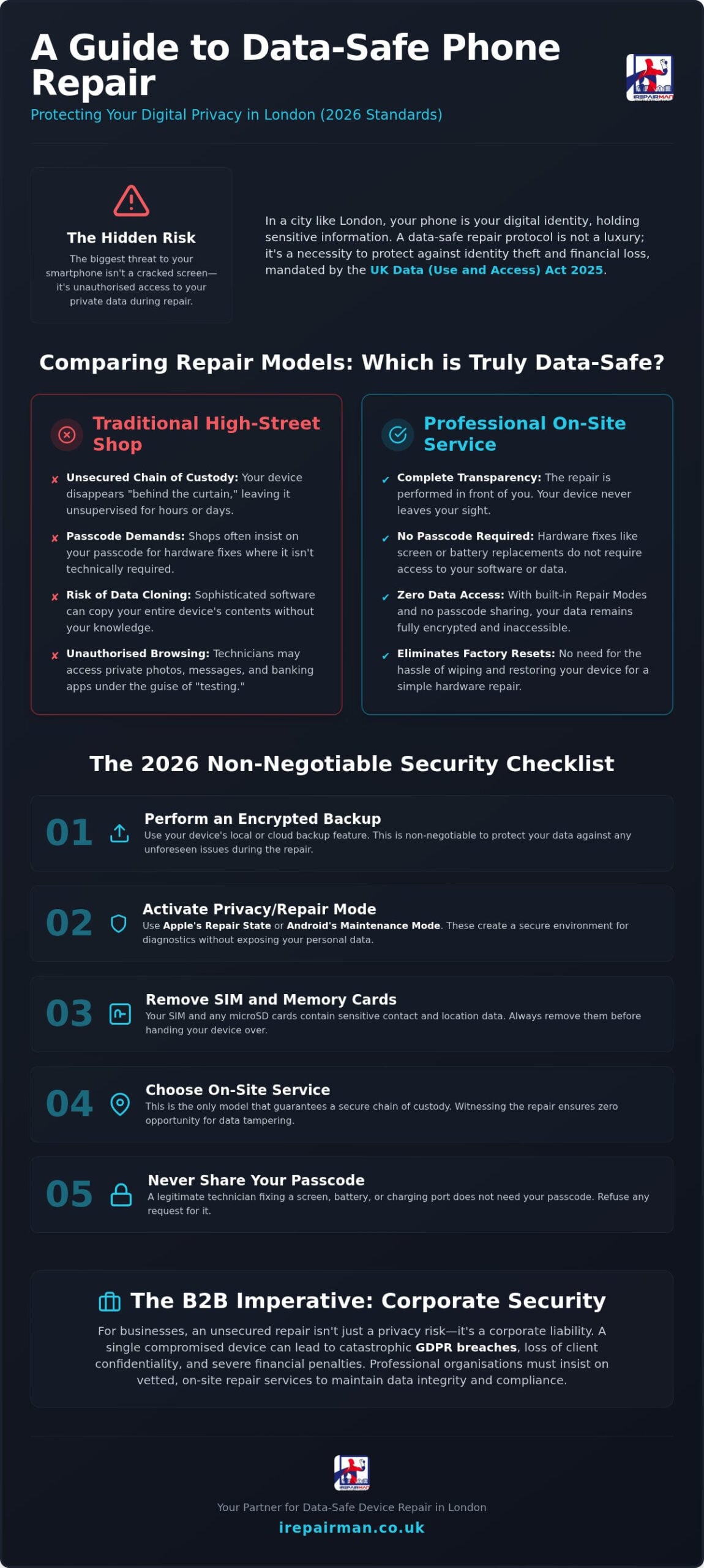
The 2026 Security Checklist: 5 Steps Before Your Repair
Preparing for a data safe phone repair London requires more than just backing up your photos. It involves a systematic lockdown of your digital and physical assets. For Samsung Galaxy users, ensure that Knox security is active and that your secure folder is locked with a unique biometric or PIN. This hardware-based security layer provides an additional barrier that remains effective even if the main OS is accessed. By following a strict pre-repair workflow, you eliminate the “human factor” risks that lead to data breaches. Your privacy shouldn’t be left to chance.
Step 1-3: Backup, Lock, and Encrypt
First, verify that your cloud backup is current. Check that it includes third-party app data, such as WhatsApp history and banking configurations, which are often excluded from default settings. Once your data is safe in the cloud, enable Lockdown Mode if you’re an iPhone user or use a high-security profile on Android. Lockdown Mode is the ultimate defence against sophisticated digital intrusion. It restricts certain functionalities and blocks message attachments, making it nearly impossible for malicious software to be sideloaded during a hardware fix. Finally, ensure your device’s internal storage is fully encrypted before handover. This ensures that even if the physical memory chips were accessed, the data would remain unreadable gibberish without your unique key.
Step 4-5: Physical Prep and Technician Vetting
Physical security is just as vital as digital encryption. Remove your SIM card, microSD cards, and any sensitive accessories like high-capacity battery cases that might have integrated storage. When selecting a provider, don’t just look at reviews; verify the technician’s credentials and their company’s privacy policy. A legitimate firm will have a clear, written commitment to UK privacy standards. Follow the “Sight-Line” rule: always insist that the repair happens in a shared or visible space. If you’re at home or in the office, ensure the technician works on a flat surface where you can see their hands and the device at all times. This visual accountability is the strongest deterrent against unauthorised browsing.
Once the hardware is restored, perform “Post-Repair Hygiene.” Check your device’s access logs to see if any unusual login attempts occurred. Re-enable any security features you disabled for the fix and, as a final precaution, update your primary device passcode. If you want to ensure these steps are handled by a professional who respects your boundaries, book your secure on-site repair with iRepairMan London today. Taking these five steps ensures that your device returns to you functional, clean, and completely private.
IRepairMan London: Professional Integrity and On-Site Transparency
iRepairMan London operates on a “Data-First” philosophy. This means every procedure is designed to protect software whilst repairing hardware. For a truly data safe phone repair London, we eliminate the “black box” risk by bringing the workshop to you. Our technicians work directly in your presence, whether you’re at a coffee shop in the City or a home office in Kensington. This visual transparency ensures that your device never leaves your sight, providing an immediate and absolute guarantee of privacy. It’s about personal accountability. We treat your device as a critical asset, not just a piece of broken glass.
Our specialised B2B Phone Repair HUB serves London firms with the most stringent security requirements. We understand that for corporate clients, a hardware failure is a potential compliance risk. This commitment extends to our emergency airport repairs, where travellers with sensitive data need immediate, secure fixes before a flight. By using premium parts that fully support biometric security features like FaceID and TouchID, we ensure your device’s defensive layers remain intact. Low-quality components can often break these secure enclaves; we refuse to compromise your safety for a cheaper part. Your security features will work exactly as the manufacturer intended.
Why Central London Professionals Trust Our On-Site Service
Busy professionals choose our on-site model because it removes the downtime and anxiety of traditional repairs. We maintain a strict “No Data Access Required” policy for the majority of hardware fixes. If we’re replacing a screen or a battery, we don’t need your passcode. Corporate clients frequently commend our discreet and secure behaviour, noting that our technicians treat their workspace with the same respect as the sensitive data on their devices. It’s a high-end service for high-stakes environments. Efficiency meets integrity. You stay in control of your device from the moment we arrive until the repair is complete.
Booking Your Secure Repair Today
Scheduling your visit is a straightforward process designed for maximum clarity. Whether you require an iPhone screen replacement, an iPad glass repair, or a Samsung restoration, our team provides transparent pricing from the start. We communicate every security step before the technician arrives so you know exactly what to expect. No hidden fees. No data risks. Don’t risk your digital life by leaving your device in an unsecured high-street shop. Secure your professional on-site repair today and experience the peace of mind that comes with total transparency. Fix your phone. Keep your data. Protect your privacy.
Secure Your Digital Identity Today
Your smartphone is more than a tool; it’s the vault for your entire digital life. Protecting that vault doesn’t require complex technical knowledge, but it does require a commitment to transparency. By prioritising on-site fixes and following a strict security checklist, you eliminate the anxieties of traditional high-street workshops. You’ve learned that visual accountability is the only way to ensure your private data remains exactly where it belongs: in your hands.
iRepairMan London provides the professional integrity your sensitive information deserves. Our expert technicians are vetted to the highest standards, ensuring every hardware replacement is handled with total discretion. Whether you’re a corporate firm utilising our GDPR-compliant B2B HUB or an individual seeking a data safe phone repair London, we bring the solution directly to you. Don’t let a cracked screen become a security breach. Book your data-safe on-site repair in London now and restore your device with absolute peace of mind. Your privacy is our priority, and we’re ready to meet you exactly where you are.
Frequently Asked Questions
Do I need to give my passcode to the technician for a screen repair?
No, you do not need to provide your passcode for a professional screen replacement. Most hardware tests can be performed using the emergency dialler or a specific diagnostic “Repair Mode” that keeps your data encrypted. If a technician insists on your passcode for a simple hardware fix, it’s a significant security risk. Professional services prioritise your privacy by allowing you to keep your device locked throughout the entire physical repair process.
Is it safer to get a phone repaired on-site or in a shop?
On-site repairs are significantly safer because the device never leaves your physical presence. In a traditional high-street shop, your phone is often taken behind a curtain or stored in an unsecured locker overnight. This “black box” environment creates opportunities for unauthorised data browsing or cloning. By choosing a data safe phone repair London specialist who works in your home or office, you eliminate the risk of transit-related data breaches.
Will my data be deleted during a professional phone repair?
No, a standard hardware repair should not result in any data being deleted. Hardware components like screens, batteries, and charging ports are separate from the memory chips where your data is stored. However, if a device has significant logic board damage, a restore might be necessary. You should always verify that your technician follows a “Data-First” workflow designed to preserve your files and settings without requiring a factory reset.
What is “Repair Mode” and how do I enable it on my iPhone?
Repair Mode is a secure software state that allows technicians to run essential hardware diagnostics whilst keeping your personal files encrypted. On current iOS versions, you can typically enable this within the Settings menu under “Privacy & Security.” It creates a sandboxed environment where the technician can verify the new screen or battery works perfectly without having any access to your private photos, messages, or sensitive banking applications. It’s a vital digital safeguard.
Should I back up my phone before a battery replacement?
Yes, you should always perform an encrypted backup before any technician handles your device. Whilst a battery replacement is a routine physical procedure, there is always a nominal risk of a short circuit or component failure during the repair. Having a current cloud or local backup ensures that your digital identity remains protected even if the hardware encounters an unexpected issue. It is the first and most important step in any security checklist.
Can a technician access my banking apps if my phone is locked?
No, a technician cannot access your banking apps if the device remains locked with a strong passcode or biometric authentication. Modern financial applications require secondary layers of security that are tied to your unique FaceID or TouchID profile. However, if you provide your passcode or leave the device unlocked, those barriers are significantly weakened. This is why professional on-site repairs are the preferred choice for those who want to maintain absolute digital boundaries.
How does the UK Data (Use and Access) Act 2025 protect my phone repair?
The UK Data (Use and Access) Act 2025 mandates that all repair businesses adhere to strict privacy standards and professional accountability. It gives consumers the legal right to know how their data is being protected and penalises shops that engage in unauthorised browsing or data mishandling. This legislation has raised the bar for data safe phone repair London, ensuring that independent specialists must meet the same rigorous security criteria as major manufacturers.
What should I do if I suspect my data was accessed during a repair?
You should immediately change your primary device passcodes and review the access logs for your most sensitive accounts. Check the “logged-in devices” list on your banking, email, and social media apps to see if any new sessions were initiated during the repair window. If you find evidence of unauthorised access, you should report the incident to the Information Commissioner’s Office (ICO). Choosing a transparent, on-site service is the best way to prevent this situation entirely.