
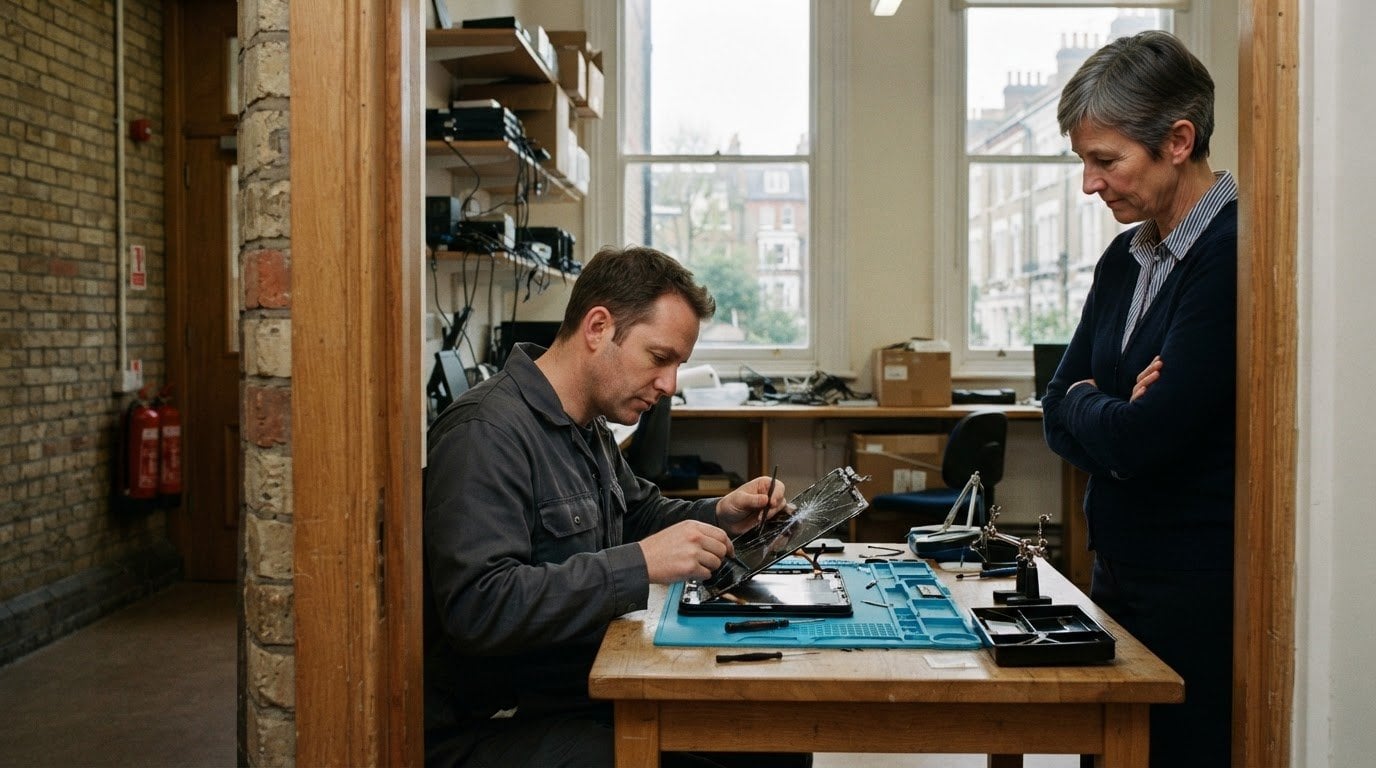
For schools in Central London, a repair visit doesn’t automatically mean a technician needs a DBS check. Whether DBS checked technicians are needed depends on the work pattern and the possibility of contact with children. A contractor working in a school at least 3 times in a 30 day period may be eligible for a DBS check, but eligibility isn’t the same as an automatic requirement.
It’s understandable that Central London schools want clear answers before arranging on-site work. A brief, supervised visit raises different safeguarding considerations from regular access during the school day. An enhanced check is also different from a check that includes barred-list information.
This guide explains when a check may apply to school repair work, which level may be relevant for regular site visits, and how supervision and access arrangements affect the decision. It also explains why a DBS certificate is only one part of a school’s safeguarding process, helping you plan repairs with clear expectations and less disruption.
Key Takeaways
- For a Central London school, whether a repair contractor needs a DBS check depends on their role, visit pattern and potential contact with children.
- Regular repair visits to a school site can make an enhanced check relevant, even when a contractor does not work directly with pupils.
- An enhanced check and a barred-list check are not the same; barred-list information applies only in specific circumstances.
- Supervision, site access and safeguarding arrangements also matter when a Central London school decides whether a contractor can carry out repairs on site.
- Learn how Central London schools and nurseries can arrange iPad screen repairs while keeping safeguarding responsibilities in view.
What Is a DBS Check for Contractors (School & Care Sites)?
A DBS check provides information about a person’s criminal record for an eligible role. For school repair contractors visiting Central London, the role, potential contact with children and supervision arrangements help determine which check may apply.
Contractor DBS Check Levels
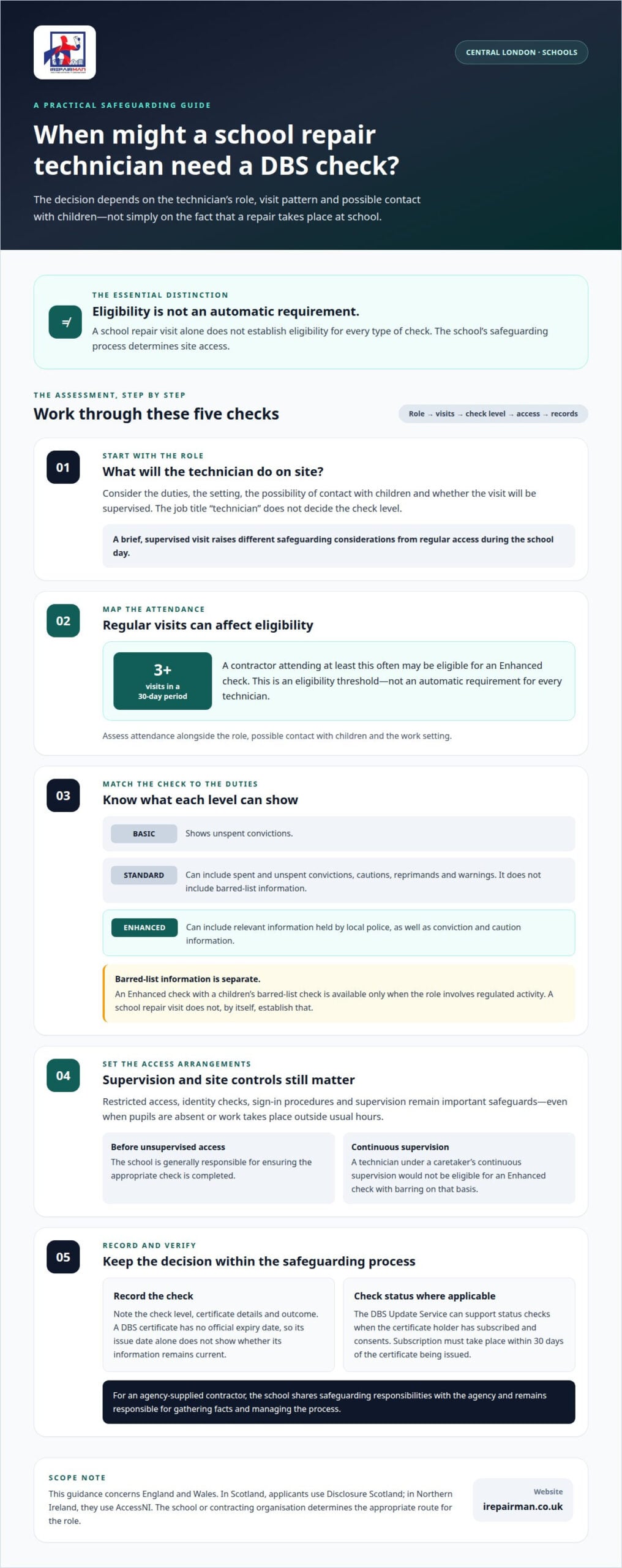
A Basic check shows unspent convictions. A Standard check can include spent and unspent convictions, cautions, reprimands and warnings. An Enhanced check can also include relevant information held by local police. Barred-list information is separate and applies only when the role makes the person eligible. A school repair visit alone does not establish eligibility for every check.
Rules differ across the UK. This guidance concerns England and Wales, including Central London. In Scotland, applicants use Disclosure Scotland; in Northern Ireland, they use AccessNI. The school or contracting organisation determines the appropriate route for the role.
Attendance and DBS Requirements
Attendance frequency can affect eligibility. Regular visits to a Central London school may make a contractor eligible for an Enhanced check, even without direct work with pupils. This is an eligibility threshold, not an automatic requirement for every technician.
Regular repair visits should therefore be assessed alongside the possibility of contact with children and the work setting. For visits to a Central London adult care home, a contractor working once a week or more, or four or more times in a 30-day period, may be eligible for an Enhanced check without a barred-list check if contact with vulnerable adults is possible.
Verifying Contractor DBS Records
Schools should record the check level, certificate details and outcome as part of their safeguarding process. A DBS certificate has no official expiry date, so its issue date alone does not show whether the information remains current.
The DBS Update Service can support status checks where the certificate holder has subscribed and consents. A person must subscribe within 30 days of their certificate being issued, according to the Disclosure and Barring Service. For agency-supplied contractors visiting Central London schools, the UK Government says schools share safeguarding responsibilities with the agency and remain responsible for gathering facts and managing the process.
Risks and Legal Responsibilities
A Central London school is generally responsible for ensuring the appropriate check is completed before a contractor receives unsupervised access. If a DBS check raises safeguarding concerns, the school may withdraw access, restrict duties or prevent on-site work.
A technician working under a caretaker’s continuous supervision, such as a plumber in a boiler room, would not be eligible for an Enhanced check with barring on that basis. Supervision, restricted access, identity checks and sign-in procedures remain important safeguards, even when pupils are absent or work takes place outside usual hours.
Technicians carrying out repairs in Central London schools do not automatically need a DBS check. Eligibility depends on their duties, possible contact with children and visit frequency. The school’s safeguarding process determines site access.
Before applying, the school and contractor should agree who will arrange and pay for the appropriate check. Under its safeguarding arrangements, the contracting organisation may need to request it.
Enhanced DBS checks for regular site work
For repeat phone and tablet repair visits to schools in Central London, the DBS check a school considers appropriate depends on whether the contractor is eligible for an Enhanced check and whether the role involves regulated activity.
Checks for Education Roles
An Enhanced DBS check gives education employers information relevant to roles involving work with children. It can include spent and unspent convictions, cautions, reprimands and warnings, as well as relevant information held by local police.
The setting and duties matter for repair work. A technician who visits a Central London school regularly may be eligible even without direct teaching or care duties, if the role creates the relevant opportunity for contact with children. That does not mean every school repair contractor needs the same check.
Enhanced and Standard Checks
A Standard DBS check can disclose spent and unspent convictions, cautions, reprimands and warnings. It does not include barred-list information, so it cannot show whether someone is barred from working with children.
An Enhanced check can include relevant local police information. This distinction matters when a Central London school assesses a role with regular site access: a Standard check may not provide the information required for an eligible education role. The check level should match the duties, not just the job title “technician”.
Barred List Checks for Repair Technicians
An Enhanced DBS check with a children’s barred-list check is available only when the person will engage in regulated activity. In England and Wales, an employer can request the barred-list check only on that basis.
A technician repairing devices in a restricted room does not automatically need barred-list screening. The deciding factor is whether the role meets the regulated-activity criteria, not simply whether the work takes place in a Central London school. The barred list identifies people unsuitable for work with children.
Regular attendance is a separate factor in check eligibility. Education guidance identifies contact with children more than 3 times within a 30-day period as the usual frequency threshold for a role requiring an Enhanced check. A contractor may meet the frequency criterion without working directly with pupils, but the work context still matters.
For example, a technician returning to a Central London school for scheduled maintenance during term time should have the visits, possible contact with pupils and level of supervision assessed before the check is matched to the role. Work during holidays, when children are absent, does not automatically remove the need for a check. The nature and timing of access still matter.
These distinctions help Central London schools avoid treating every repair contractor alike. An Enhanced check may suit an eligible role, while barred-list information requires the additional regulated-activity test. Record the duties and site arrangements alongside the check decision, so repeat repair visits are assessed consistently rather than by job title alone.
DBS checks for people working in schools
At Central London schools, the school assesses each person’s duties and access before deciding which DBS check applies. A repair technician, school employee and volunteer may have different eligibility because their responsibilities and contact with children differ. The work setting matters, but the job title alone does not determine the check. The school’s safeguarding process should record why the chosen level fits the role.
Staff employed directly by a school are eligible for an Enhanced DBS check, with applicable barred-list checks. Volunteers engaging in regulated activity in a school are also eligible for an Enhanced check with a children’s barred-list check. These categories show why a one-off device repair visit should not automatically be treated like a school employee’s role.
For contractors visiting a Central London school, the working arrangement can change the assessment. A repair technician working in a staff area under the school’s continuous supervision would not be eligible for an Enhanced check with barring on that basis. By contrast, regular access when children may be present calls for a separate assessment of duties, supervision and possible contact.
A DBS certificate belongs to the individual, but a new employer decides whether it can be accepted for a new role. An existing certificate may be accepted if the role matches and the regulatory body permits it. If the person has never had a DBS check, a new check must be carried out. A role with different duties needs its own suitability assessment.
Changed circumstances can also affect the decision. A new check must be carried out if concerns arise about a person’s suitability. Rather than relying only on an earlier certificate, the school should record the concern, the decision and any access restrictions. This keeps the safeguarding record relevant to the technician’s current role and the school’s arrangements for repair visits.
In England, a person may begin regulated activity before their DBS certificate arrives only when appropriately supervised and all other required checks are complete. These include a separate children’s barred-list check. For a repair visit, restricted access and continuous supervision can limit exposure while a check is pending, but they do not replace checks required for the role.
For agency-supplied contractors, the UK Government says schools share safeguarding responsibilities with the agency and remain responsible for gathering facts and managing the process. The school should establish who is attending, what repair work they will do and how they will be supervised. A named site contact can manage sign-in, permitted areas and any changes to the planned visit.
The Disclosure and Barring Service handles DBS checks, but the school’s decision depends on the role and eligibility rules. Keep the certificate information and assessment linked to the contractor’s duties, especially if a technician returns to a Central London school for further work or takes on a role with greater access to children.
DBS checks for Central London school repairs
For a Central London school arranging a repair visit, the appropriate check depends on the contractor’s duties and access to children. Keeping Children Safe in Education 2026 came into force on 1 September 2026, so schools should use the current version when reviewing safeguarding arrangements. A repair contractor is not automatically treated like teaching staff; the school considers the actual duties and site access.
For school employees engaged in regulated activity, an Enhanced DBS check with the relevant children’s barred-list information may apply. A barred-list check is not a routine extra for everyone entering an education setting. An employer can request it only when the role makes the individual eligible, including through regulated activity. Recruitment records should show the check level and why it fits the post.
Existing certificates can sometimes support a new appointment. Under paragraphs 238 to 240 of Keeping Children Safe in Education, a school may accept an existing certificate for an appointee moving from another school or college, subject to the stated conditions. If the role involves regulated activity, the school must still complete other pre-employment checks, including a separate barred-list check.
The DBS Update Service can help establish whether information on an existing certificate remains current. A school may use it only if the certificate holder has subscribed and consents. The certificate has no official expiry date, and schools have no legal requirement to renew checks after a fixed period. Renewal every three years is described as standard best practice, although employers may set a different interval.
Education settings also need to distinguish child and adult workforce checks. Adult Workforce and barred-list checks apply in education only to staff caring for and supporting SEND students aged 18 or older. This distinction matters where a repair visit involves pupil support as well as other duties; the school should match the check to the specific responsibilities rather than the setting alone.
For a new role, a break of more than three continuous months between roles is one circumstance requiring a new check under the education-sector guidance. A new position that gives an employee greater access to children or more responsibility also calls for a new check. Record the role change, access level and decision, so recruitment files explain why the check remains suitable.
For contractors visiting a Central London school, use the same role-based approach without assuming school staff rules automatically apply. A scheduled repair visit, supervised access and work around teaching hours involve different arrangements. Before granting access, document the planned duties, supervision and relevant certificate status. This helps the school apply safeguarding procedures consistently if the technician returns or the work changes.
Types of DBS check required
For Central London school repair visits, the appropriate check depends on the technician’s role and the information the school is eligible to request. Before arranging site access, assess the repair duties, pupil contact and supervision. A school address alone does not determine the check level.
- Basic: shows unspent convictions and conditional cautions.
- Standard: can show spent and unspent convictions, cautions, reprimands and warnings, but excludes barred-list information.
- Enhanced: includes relevant information held by local police, alongside information available through a Standard check. Barred-list information may be added only when the role is eligible.
These check levels are not interchangeable. A Standard check may suit a Central London school repair role eligible for that level, but it cannot establish whether someone appears on a barred list. An Enhanced check provides broader information, yet a school cannot request one simply because a technician is visiting an education setting. Eligibility depends on the work and access involved.
For a repair visit at a Central London school, consider whether the technician could have contact with children, how often they attend and whether supervision is continuous. A technician working in a restricted room under staff supervision has a different arrangement from someone carrying out duties involving regulated activity. The job title “repair technician” does not settle the question.
An Enhanced check with a children’s barred-list check is available only when the individual will engage in regulated activity. The barred list identifies people barred from working with children. When children are present during a school repair visit, assess the role and safeguarding arrangements before deciding which check is appropriate. Barred-list information still depends on eligibility.
Some education roles involve adults rather than children. Adult Workforce and Adults’ Barred List checks apply in education only to staff caring for and supporting SEND students aged 18 or older. A repair visit near adult learners does not alone establish eligibility for those checks; the person’s actual care and support duties matter.
When an agency supplies a technician for a Central London school visit, agree the check level and safeguarding arrangements with the agency before granting access. Record the duties assessed and the reason for choosing a particular level. This ties the application to the planned repair visit rather than relying on a broad contractor label.
A certificate has no official expiry date. If the holder has subscribed to the DBS Update Service and consents, the school can use it to check whether the certificate remains current. This status check supports, but does not replace, the school’s assessment of the technician’s role, permitted access and eligibility for barred-list information.
IRepairMan London: Schools & Nursery iPads screen repairs
iRepairMan London provides on-site iPad screen repairs for schools and nurseries across Central London. If an iPad screen is cracked or unresponsive, arrange a same-day visit at your school or nursery, subject to availability, to reduce disruption to lessons and daily routines.
The repair service and DBS decision are separate matters. Schools remain responsible for assessing contractor access, supervision and the check required for each role. Set out the planned repair work and site arrangements so the visit fits the school’s safeguarding process.
For other device repairs, iRepairMan London also offers iPad Repairs, iPhone Screen Repair and iPhone Back Glass Repair. The right repair depends on the device and the damage.
Contact iRepairMan London to discuss school or nursery iPad screen repairs in Central London and arrange a convenient visit.
Plan the next school repair with confidence
Before arranging a repair visit in Central London, align the work plan with your school’s safeguarding process. Specify the device, repair needed, permitted work area and supervision arrangements, then have the school assess the role for DBS purposes. Clear plans help staff manage access and keep the repair focused and organised.
Choosing DBS-checked technicians for school repairs should be part of that planning, not a substitute for the school’s assessment of each role. Keep the repair booking separate from the site-access decision, so the appropriate safeguarding process remains in place as you arrange the work at your Central London school.
For damaged school iPads, iRepairMan London offers Schools & Nursery iPads screen repairs and iPad Repairs. Other services include iPhone Screen Repair and iPhone Back Glass Repair. Share the device, repair need and your Central London school’s location when you get in touch, so the conversation can focus on the service your school requires.
Contact iRepairMan London to discuss a school or nursery device repair in Central London. A clear next step can help your team plan the work with confidence.
Frequently Asked Questions
Is a DBS check needed for a school repair visit in Central London?
Not everyone entering a Central London school needs a DBS check. The school assesses the repair technician’s role, possible contact with children, visit pattern and supervision. For example, a technician escorted throughout a repair in a locked staff area has different access from someone working around pupils during lessons. The school should make its safeguarding decision before confirming access, rather than treating every visitor alike.
What DBS check level is required for repair technicians visiting Central London schools?
The appropriate level depends on the technician’s duties and eligibility. A Standard check can show convictions and cautions, while an Enhanced check can include relevant police information. Barred-list information is available only for eligible roles involving regulated activity. A technician repairing a device in a supervised room may have different eligibility from someone whose duties involve regular contact with pupils.
How can Central London schools verify a repair technician’s DBS certificate and identity?
Schools can record certificate details and verify identity as part of their safeguarding and site-entry processes. If the certificate holder has joined the DBS Update Service and consents, the school can use it to check whether the certificate remains current. On arrival, staff can compare the technician with the identity details recorded for the visit and follow the school’s sign-in procedure.
Can a Central London school accept a DBS check obtained by a repair company or another employer?
Sometimes. A school may accept an existing certificate when the role matches and the relevant regulatory body permits it. For example, a certificate for one repair role may not suit a new visit with broader access to pupils. The school must still complete other required checks for the appointment, including a separate barred-list check if the role involves regulated activity.
How recent does a DBS check need to be for repair technicians visiting Central London schools?
A DBS certificate has no official expiry date, and schools have no legal duty to renew checks after a fixed period. In practice, settings may expect a certificate issued within the previous three years or an active DBS Update Service subscription. If a technician returns after a long gap, the school should assess the current role and its safeguarding policy, not rely on the date alone.
What procedures should Central London schools follow to arrange repairs by DBS-checked technicians?
Before booking, the school should define the repair, work area and likely contact with pupils, then assess the technician’s role under its safeguarding process. Arrange sign-in, identity checks, supervision and access limits for the visit. If an agency supplies the technician, agree how safeguarding information will be gathered and managed. These arrangements help the school coordinate the repair while retaining control of site access.